 Misty Paig-Tran, Ph.D.
Functional Anatomy, Biomechanics, and Biomaterials (FABB)
Misty Paig-Tran, Ph.D.
Functional Anatomy, Biomechanics, and Biomaterials (FABB)

California State University Fullerton Follow Misty on Twitter @FABBLab
Bioinspiration Lab at California State University Fullerton
Sharks, rays, whales, and other critters. Nature is our inspiration.
The FABB Lab explores performance in organisms ranging from plankton to the largest organisms on Earth (baleen whales). The lab operates at the interface of biology and materials science. The majority of our work is focused within the marine realm, though from time to time we investigate performance in terrestrial critters.

FABB Lab Fall 2018. Back: Raj Divi, Andrew Lowe, Ryan Fitterer, Ashleigh Davis, Jacob Javier
Front: Lindsay Maldonado, Misty Paig-Tran (PI), Leslie Barron

Research focus
Animal performance and bio- inspiration.
Evolution and performance of filter-feeding in sharks and rays (whale sharks, basking sharks, megamouth sharks and manta/mobula rays).
This work is supported in part by:
- National Science Foundation
- CSU COAST
- CSUF Jr/SR Granting
- CSUF Violet Horn Funding
- CSUF Coppel Funding
- CSUF Hillman-McClanahan Funding
FABB Lab in the news

BBC World News mantas as filters for microplastics
Microplastics in sardines (Spectrum news)
Microplastic in Pacific sardines (CSUF)
Shark School at California Academy of Sciences. Learn about why Whale sharks are the true murder beasts of the sea.
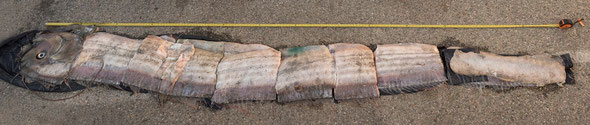
Oarfish with BYU podcast
https://www.byuradio.org/60499e70-454e-4a1a-bedc-1dc597f57747
National Geographic Feature on Corydoras
https://www.nationalgeographic.com/animals/2021/01/tiny-catfish-shrugs-off-piranha-bites/
Bad Science Podcast The Shape of Water
https://podtail.com/en/podcast/bad-science/the-shape-of-water-w-steph-tolev/
Bad Science Podcast Finding Nemo
https://podtail.com/en/podcast/bad-science/finding-nemo-w-jackie-tohn/
KFI Radio
http://www.kfiam640.com/onair/bill-carroll-37820/weird-science-they-mystery-of-the-13870282/
Daily Breeze
Science Friday NPR Manta Ray Gill Rakers 2014
http://www.sciencefriday.com/video/10/23/2014/no-strain-no-gain-filter-feeding-mantas.html
Science Friday NPR Oarfish 2014
http://www.sciencefriday.com/video/07/24/2014/oarfish-the-ultimate-fish-tale.html
Radio feature:
http://www.sciencefriday.com/playlist/#play/segment/9490
Daily Titan
http://www.dailytitan.com/2014/11/applying-natures-miracles-for-practical-solutions/
Clearing and staining
http://blogs.kqed.org/science/2014/01/07/stunning-fish-skeletons-serve-science-and-art/
Crowd funding
https://asunews.asu.edu/20140106-imaging-future
2013 Oarfish work
PBS Interview
http://video.pbssocal.org/video/2365116093/
New York Times
Nature article
http://www.nature.com/news/oarfish-s-misfortune-is-scientists-boon-1.14040
Fullerton
http://www.dailytitan.com/2014/05/assistant-biology-professor-studies-oarfish/
http://news.fullerton.edu/2013fa/oarfish-scan.asp
http://news.fullerton.edu/2013fa/oarfish.asp
http://www.dailytitan.com/2013/10/csuf-professor-studies-oarfish-remains/
http://www.dailytitan.com/2013/12/csuf-marine-biologist-makes-waves-in-oarfish-research/
UCLA
http://today.ucla.edu/portal/ut/radiologists-reveal-structure-249546.aspx?link_page_rss=249546
2013 Six-gill shark research
Pictures
http://www.science.fau.edu/
San Juan islander article
http://www.sanjuanjournal.com/
Mantas and whale shark research
2013 California State University Press release & full article - Devil ray research
http://news.fullerton.edu/2013fa/mantra-ray-study.asp
http://contentstore.fullerton.edu/news/2013fa/rays-study-paig-tran%20.asp
2013 San Juan Islander
2013 University of Washington press:
2013 American Microscopical Society: http://amicros.org/?page_id=534
2013 Friday Harbor Laboratories feature: http://depts.washington.edu/fhl/enews/winter2013/misty.html
2011 Inside JEB Feature:
http://jeb.biologists.org/content/214/10/iii.full?sid=15d40910-ebf1-449c-81ad-fdc564782013
2011 American Elasmobranch Society: http://elasmo.org/pastawardwinners.php
2010 UCI COSMOS program
http://news.uci.edu/features/summer-by-the-numbers/
http://www.cosmos.uci.edu/news09-week1.html
http://www.flickr.com/photos/ucirvine/8638041959/
I am affiliated with Manta.org. Please visit this site to learn more about other ongoing manta ray research.
For a link to my work from FHL visit
http://depts.washington.edu/fhl/enews/winter2013/misty.html
All images on this website belong to Misty Paig-Tran, The Journal of Experimental Biology, and the Journal of Morphology. Please feel free to use these images for presentations as long as you properly credit the images. No images may be shared for other purposes, including websites, without my permission.